
CEO Salary and Pay
Chief Executive Officers carry the ultimate P&L mandate – crafting strategy, liaising with investors, and steering culture. Every key stakeholder, from the board chair to the bondholder, uses the CEO’s vision as a yardstick; therefore, base pay and bonus potential escalate quickly with revenue growth, headcount, and increasing regulatory complexity.
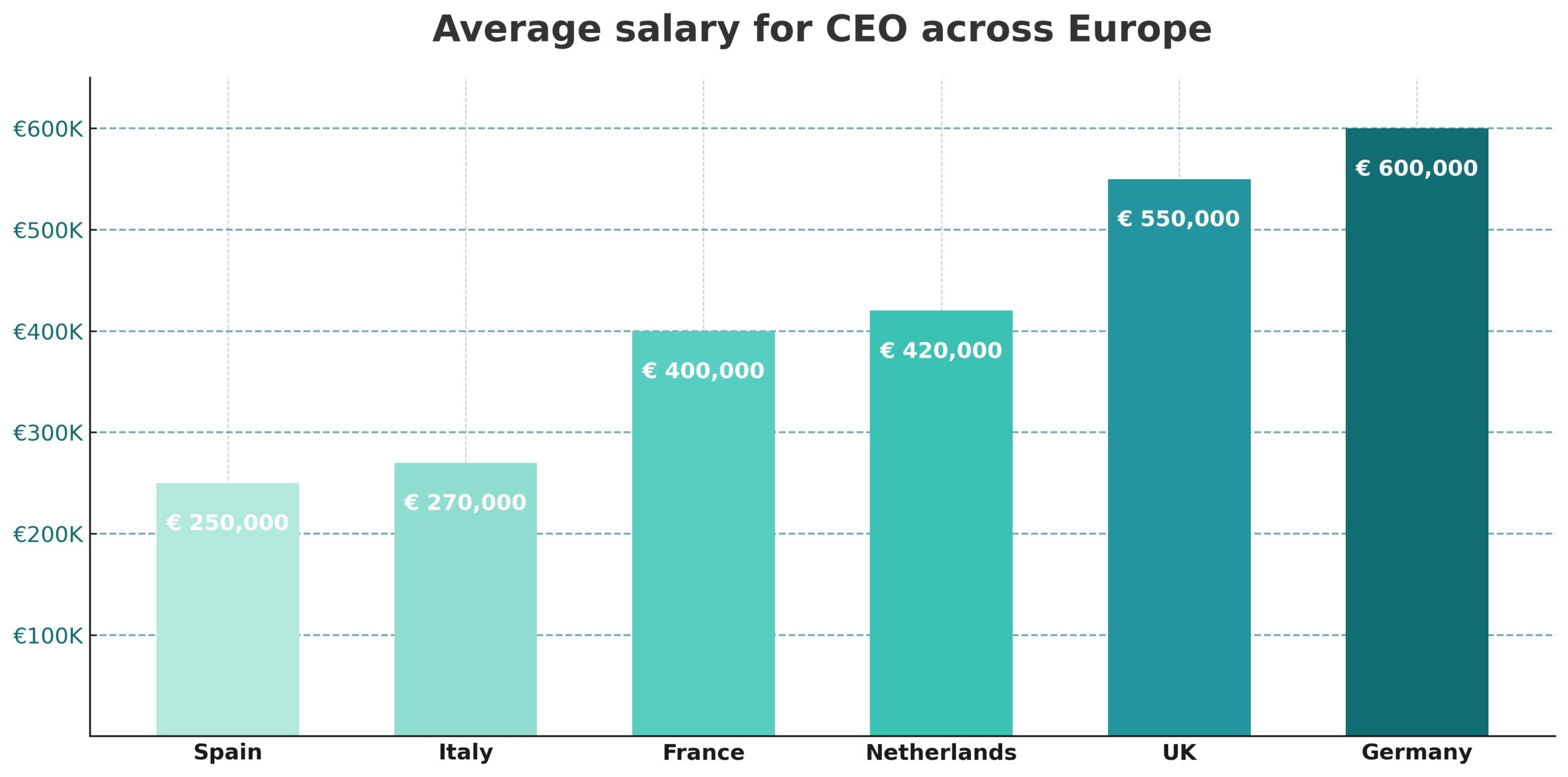
(Salaries may vary depending on the industry, experience, and company policies. We based the above figures on estimates from Payscale.com.
European Salary And Pay
CEO salary and pay 2025 averages reveal eye-watering gaps among European markets. Southern CEOs still break the six-figure threshold—about €250,000 in Spain and €270,000 in Italy—but lag far behind those in the north. Continental mid-tier leaders surge ahead: France centres on roughly €400,000 and the Netherlands on €420,000, driven by multinational HQ exposure. In Europe’s largest capital markets hubs, pay rockets: a UK top boss earns ≈ £ 470,000 (≈ € 550,000), while Germany’s DAX giants push average packages to around € 600,000. Note that these are base cash; long-term incentives can easily double total compensation at public and PE-backed firms.
UK Salary And Pay
The United Kingdom has a successful business history. Its approach to CEO pay has changed over time in response to different factors. The UK aims to reward people for meeting the expectations of shareholders and other stakeholders based on performance. They aim to be more transparent, accountable, and responsible in their executive compensation practices. Various trends have influenced CEO compensation in the UK. These trends have led to changes and challenges, prompting people to seek fair payment practices.
In the early years, CEO compensation in the UK was primarily comprised of fixed salaries and small bonuses. Yet, as global markets expanded and competition intensified, executive pay structures evolved. They began to focus more on performance-based incentives, such as stock options and equity grants. Shareholders in the UK became more active in the late 20th century. They wanted executives to be more transparent and accountable when deciding pay. Shareholders vote on executive pay to link rewards with performance and align them with shareholder interests.
The financial crisis in the late 2000s prompted people to examine how executives were compensated. People wondered if the problem came from taking too many risks for quick profits. In the early 2000s, Derek Higgs (2003) and Sir David Walker (2009) wrote influential reports. These reports emphasised the importance of effective corporate governance and equitable executive compensation. The reports suggested having more independent board members. They also suggested clear payment rules and better communication with shareholders.
The UK has rules and requirements to make executive compensation more transparent and monitored. The Companies Act 2006 required companies to disclose executive pay details in their annual reports. This helps shareholders and the public better understand executive pay packages.
UK shareholders want to promote diversity and long-term value creation. Companies collaborate with investors and advisors to decide fair and ethical compensation. Companies are linking executive pay to long-term value and sustainability. UK companies are increasingly considering environmental, social, and governance (ESG) factors when determining compensation. They understand that CEOs’ decisions have far-reaching effects that extend beyond financial metrics. The UK’s focus on diversity and gender equality has also extended to executive compensation. Companies face pressure to reduce gender pay gaps and promote executive diversity. This has sparked conversations about fairness and compensation practices.
CEO Compensation Packages
The compensation packages of top CEOs offer a glimpse into the intricate world of executive compensation. When examining various industries and countries, we can gain insight into why salaries are high in these sectors. This is due to factors such as competition and regulations.
CEOs’ pay comprises many components, making it a complex and intricate system. These parts ensure that the CEO’s goals align with the company’s performance, long-term value, and what shareholders expect. Here are some standard features of CEO compensation packages:
The CEO receives an annual bonus, which is a cash payment that can change. The bonus is awarded for meeting short-term goals, such as financial targets or operational milestones. 96% of FTSE 100 companies paid their CEO a bonus in 2022, compared to 87% in 2021. Yet, the mean bonus payment decreased from £1.43 million in 2021 to £1.41 million in 2022 (highpaycentre.org).
Long-term incentives align the CEO’s pay with the company’s performance over a prolonged period. They encourage CEOs to make decisions that will impact the company’s trajectory over several years. Seventy-four per cent of FTSE 100 companies paid their CEOs a long-term incentive payment (LTI), up from 71% in 2021. The mean LTI payment increased from £1.49 million in 2021 to £1.79 million in 2022 (highpaycentre.org). A common form of LTI includes equity grants, which provide the CEO with ownership in the company. These can consist of stock options, RSUs, or performance shares.
Stock options are a way for CEOs to purchase company stock at a predetermined price, incentivising them to increase the stock’s value.
RSUs are shares of company stock granted to the CEO, but they can’t be sold or exercised right away.
Employees earn performance shares by achieving goals, such as increasing revenue or meeting financial targets.

Unsplash+In collaboration with Getty Images
Contributions to retirement plans, like pensions, can accumulate over time. Deferred compensation plans may allow CEOs to defer a portion of their salary or bonus until a later date.
Perks and Benefits: CEOs receive non-cash benefits as part of their compensation package. Employees receive perks such as cars, health coverage, housing assistance, club access, and personal assistants.
If the CEO’s job ends, these rules explain what happens, especially during business combinations. Severance packages may include cash payments, continued benefits, and accelerated vesting of equity.
Criteria for CEO Compensation Packages
CEOs’ pay is often designed to strike a balance between short-term results and long-term value creation. This way, the CEO’s goals match those of shareholders and stakeholders. The compensation committees and boards of directors consider these components. They do this to make sure they support the company’s strategic objectives and responsible governance. The CEO’s job contract often includes conditions that must be met to be eligible for a substantial salary.
Performance measures impact the CEO’s eligibility for equity awards and bonuses. These metrics vary based on industry, company size, and strategic priorities.
To encourage good behaviour, companies now use ESG, or environmental, social, and governance metrics, to determine CEO pay.
Clawback provisions allow a company to recover money paid out when certain conditions are met. These conditions can include financial restatements due to misconduct.
Compensation Trends in Different Industries
We can gain insight into executive compensation by examining CEO pay across various industries. The pay varies depending on company size, performance, demands, and market conditions. Let’s examine the compensation of CEOs in technology, finance, and healthcare, as these industries often offer substantial rewards.
Tech and pharmaceutical companies offer more compensation through equity grants due to potential stock price growth. Finance companies also include equity, but it’s lower due to regulatory considerations.
The performance bonus is the same in all industries and rewards short-term achievements. The percentage is higher in the technology sector due to its rapid growth and innovation.
Compensation: Pharmaceutical and technology CEOs receive higher compensation than their counterparts in healthcare and finance. The technology sector has considerable growth potential. Pharmaceutical companies invest in research and development. This makes a difference.
Finance companies have rules that limit how they pay their employees. This is why the finance industry has lower equity and bonus payments.

Unsplash+In collaboration with Getty Images
Remember, CEO pay can vary within industries due to factors such as company size, performance, and others. Comparative analysis like this provides a snapshot of trends but needs to capture the full complexity of executive pay. To conduct thorough research, use reliable industry reports, company filings, and compensation studies.
Factors Driving High CEO Salaries
The large salaries of CEOs have become a subject of intense debate and scrutiny. To understand executive compensation and corporate governance, we need to know why pay is high.
CEOs make a lot of money because companies need them; there aren’t many skilled people. To have more effective discussions about executive pay, we need to understand these key factors. This will help align CEO incentives with shareholder interests and make sure CEO pay is fair and accountable.
These factors influence high CEO salaries. People are discussing aligning executive pay with the interests of shareholders and stakeholders. They also want to address income inequality and promote responsible corporate governance.
The following list provides the factors driving high CEO salaries:
- Market Demand for Top Talent: CEOs are responsible for leading and driving the strategic direction of companies. In a competitive business world, the need for skilled leaders raises executive salaries.
- There aren’t enough skilled leaders to fill top positions in big companies. The scarcity makes CEOs more powerful in negotiations, allowing them to receive higher compensation.
- High salaries often come with bonuses, stock options, and equity grants that are contingent upon achieving specific performance targets. These parts link CEO pay to a company’s performance, so CEOs make choices that benefit shareholders.
- CEOs who drive company success and increase shareholder value are often rewarded with higher compensation.
- Modern corporations are complex and large, so CEOs must manage many tasks and make important decisions. This is why they receive higher compensation. CEOs of large companies have numerous responsibilities, so they are often compensated more to stay in their positions. These companies operate globally and have many business units.
- Industry Competition. Industries such as technology and finance compete for top talent, offering higher pay to attract CEOs who can give them a competitive advantage. Shareholders expect CEOs to deliver strong financial results and returns to shareholders. Companies might offer higher payments to secure CEOs with proven track records.

Unsplash+In collaboration with Getty Images
- To stay competitive, compensation committees and boards compare CEO pay to that of peers and competitors. This benchmarking process can lead to an upward spiral in executive pay. Prevailing corporate governance practices and market norms can influence executive compensation decisions. Sometimes, these norms lead to higher pay levels to remain competitive.
- Market Perception and Reputation: A CEO’s reputation and market perception can impact a company’s success. Hiring a skilled CEO can enhance the company’s reputation, potentially leading to increased compensation. Large investors can influence CEO pay by engaging in and voting on executive compensation proposals, as well as advocating for more equitable compensation.
Comparative Analysis: Global and European Perspectives
Executive pay varies globally due to economic conditions, cultural norms, regulations, and corporate governance practices.
When we compare executive pay worldwide and in Europe, we see how economics, culture, and regulations are connected. To discuss executive pay, governance, and shareholder interests, you must comprehend these distinctions.
The US is the highest-paying country in the world for CEO compensation. Stephen Schwarzman, the CEO of Blackstone, received the highest pay in 2022. He earned $253 million. Sundar Pichai of Alphabet came in second, earning $226 million. Stephen Scherr, CEO of Hertz, came in third with total earnings of $182 million.
In a world where companies are connected, they learn from different perspectives. This shapes executive compensation globally.
In this section, we will compare executive compensation worldwide and in Europe. We’ll examine various practices, trends, and challenges facing companies and policymakers.

Unsplash+In collaboration with Ave Calvar
Historical Evolution of CEO Compensation
The history of CEO pay shows how business, economics, and governance have changed. Now, we’ll examine the key events and patterns that influenced CEO pay over time.
In the early years of corporate development, CEO pay was low and often tied to business performance. Shareholders saw the CEOs as stewards who acted in their best interests.
Performance-Based Compensation Era: In the mid-20th century, we shifted toward performance-based compensation. The CEO’s pay is based on their performance and the company’s stock price. This connects their interests with those of shareholders. This created a bond between the CEO and the company’s success.
In the late 20th century, the “superstar” CEO became a popular trend. Companies sought CEOs who were effective leaders and had experience in reviving struggling companies. CEOs said they deserved high pay because talented people wanted a lot of money. During this shift, the focus was on generating revenue quickly. This resulted in CEOs receiving large pay packages through stocks and bonuses.
CEO pay became high in the late 1990s and early 2000s. This worried shareholder activists and corporate governance advocates. We learned from the Enron scandal and other corporate failures that executive pay should be transparent and accountable. Shareholder activism gained momentum as investors demanded a better alignment between pay and performance.
In response to increasing concerns, regulatory interventions began to shape CEO compensation. In 2010, the United States enacted the Dodd-Frank Wall Street Reform and Consumer Protection Act. Shareholders could vote on executive pay to express their approval or disapproval. Similar regulatory changes also occurred in other countries, emphasising transparency and shareholder input.
Current Focus
In recent years, CEOs have been rewarded for creating long-term value instead of short-term gains. Performance metrics now take into account environmental, social, and governance (ESG) factors, in addition to financial considerations. CEOs are now seen as having a bigger influence on their companies and society.
The disparity in pay between CEOs and workers has sparked discussions on income inequality and corporate ethics. People want fair pay and wealth distribution. Activists, academics, and policymakers are advocating for this.

Unsplash+In collaboration with Getty Images
Common Challenges
Shareholder activism is on the rise. Institutional investors and shareholders have a greater influence on determining executive compensation. They use “say-on-pay” votes and engagement to shape these decisions.
Executives’ pay should be tied to the company’s performance and its ability to sustain value.
Compensation structures encompass non-financial metrics, including environmental, social, and governance factors.
There is a growing focus on addressing the gender pay gap and promoting diversity in executive ranks.
Regulatory Reforms: Legislative interventions enhance transparency, accountability, and responsible executive compensation practices.
CEOs’ Pay in Startups
In startups, CEO compensation can vary depending on factors such as stage, industry, funding, location, and experience. Startups often need to balance attracting top talent with managing limited resources.
According to research by Kruze Consulting, the average salary of a startup CEO in the USA was $142,000 in 2023, down from $150,000 in 2022. The salary survey website Glassdoor reports that the average base pay of a startup’s co-founder and CEO in the UK was £127,287 in 2023.
Various factors contribute to the pay fixation of CEOs in startups, such as:
- Industry and Location: The nature of the startup’s business and its location can impact CEO compensation. Tech startups may offer higher equity stakes due to the potential for rapid growth and high valuations. The location of the business matters. CEOs in expensive cities may receive higher salaries to attract top talent.
- Stage of Startup. In the early stages, when a startup is getting off the ground and has limited funding, the CEO might not receive a large salary. Instead, they might take a lower base salary in exchange for equity in the company. Equity can be in the form of stock options or equity grants, aligning the CEO’s interests with the startup’s success. In certain situations, when CEOs are also co-founders, they may decide their own pay. They might even work without pay, driven by their passion for the business.
- Growth of Startups: The CEO’s compensation might evolve as the startup secures funding and grows. The CEO may receive a competitive salary and bonuses based on achieving specific goals and milestones. Equity compensation remains vital because the CEO’s role in the company’s success is pivotal.
- CEOs of well-funded and growing startups can earn salaries like those of established companies. These salaries encompass base pay, bonuses, and equity compensation. CEOs at this stage manage large teams, plan for growth, and attract additional investment.
- The CEO’s experience and track record also play a role in determining salaries. CEOs who have built and grown startups may earn more money and stock options due to their proven skills. Startups focus on equity ownership because a significant financial reward can be realised when they exit. Determining a CEO’s compensation in a startup involves several key factors, including the company’s financial health, growth trajectory, competitive landscape, and skill set.
Gender Gap in CEO Pay
The gender gap in CEO pay refers to the disparity in compensation between male and female chief executive officers (CEOs). This gap reflects broader gender inequalities that exist in the workforce and society as a whole. Oracle’s Safra Catz is the only woman among the top 10 highest-paid CEOs, according to a report by CNBC (cnbc.com). According to the High Pay Centre, female CEOs in the United Kingdom earned £3.91 million, which is comparable to the median income of £3.96 million for male CEOs in the FTSE 100.
The pay gap occurs because women are underrepresented in top leadership roles, such as CEO positions. Women may face obstacles, including biases, stereotypes, and barriers, that hinder their career growth. As of July 2022, Fortune 500 companies have 44 women CEOs, accounting for 8.8% of the total. Among the Fortune 1,000 (501–1000), there are 37 women CEOs, representing 7.4%.

Photo by Meghan Lamle on Unsplash
According to a report from CEOWORLD magazine, as of August 2023, there are currently nine women who are chief executives in the FTSE 100. The FTSE 100 is a group of the biggest businesses traded on the London Stock Exchange. This means that 9 per cent of these companies have female CEOs. Although the number has improved from six female CEOs in 2019, progress could still be much faster.
Some key factors contributing to the gender gap in CEO pay are listed below:
- The glass ceiling is an unseen barrier that stops capable women from reaching top leadership positions. This phenomenon can limit women’s opportunities to become CEOs and influence the pay gap.
- Studies reveal that women request fewer raises and promotions, which can impact their earnings and career growth.
- Women often work in lower-paying sectors and roles, limiting their access to higher-paid CEO positions.
- Women often have to take on many caregiving duties, which can disrupt their careers and hinder their path to CEO positions. By offering paternity leave and flexible work schedules, companies can encourage men to take an active role in caring for their children. This enables women to undertake more challenging tasks and be relieved of traditional childcare responsibilities.
- A lack of mentorship and sponsorship can limit women’s access to the networks and relationships needed to become CEOs.
- Some people believe that women are less likely to take risks. This belief may impact their suitability for CEO positions that require bold decision-making.
- When executive pay and diversity data are not transparent or disclosed, gender bias in CEO pay can continue unchecked.
- Gender stereotypes affect how people view effective leaders, which can disadvantage women in evaluations and pay decisions.
- To address the pay disparity between male and female CEOs, several steps need to be taken. First, we should address the unfair practices that favour one gender. Second, we should encourage more diversity in leadership positions. Third, we should offer more opportunities for mentors and sponsors. Fourth, we should challenge the idea that certain jobs are only for one gender. Finally, we should create organisational cultures that include everyone.
- To reduce the gender pay gap and promote gender equality in the workplace, several steps can be taken. First, we can make payment information more open. Second, we can create policies that support families. Third, we can provide opportunities for leadership development.

Unsplash+In collaboration with Getty Images
The CEO-Worker Pay Ratio
The difference in pay between CEOs and workers is causing conflict in discussions about fairness. The disparity in income between CEOs and average workers has numerous significant effects on society and businesses.
A report from Reuters in August 2023 said that S&P 500 chief executives made $16.7 million in 2022. This is 272 times more than what their median workers earn. A report by the Economic Policy Institute (epi.org) suggests that the CEO-to-worker compensation ratio reached 399-to-1 in 2021, a new high.
According to the High Pay Centre, in 2022, FTSE 100 CEOs earned an average of £3.91 million. This is 118 times higher than the earnings of a full-time worker in the UK, which is £33,000. The CEO at AstraZeneca earned the most, receiving £15.32 million. These figures are 464 times the median annual pay of a full-time UK worker. The median FTSE 250 CEO was paid £1.77 million in 2022, which is 54 times the median yearly salary of a UK worker.
To promote fair economic growth, it’s crucial to grasp the causes and impacts of income inequality on workplaces. By understanding this, we can ensure that compensation practices are fair.
Factors Driving the Gap
Economic, societal, and corporate factors contribute to the widening gap in CEO and worker compensation. This gap keeps getting bigger. Statistical data shows the significant difference in compensation between CEOs and workers. It also talks about how this affects income inequality and organisations. This disparity has raised concerns about income inequality and social justice. The following are some key factors driving the gap between CEO and worker compensation:
- The scarcity of qualified CEOs and the high demand for executive talent can lead to increased compensation. When there aren’t many experienced CEOs available, their pay can go up. However, when there are numerous workers in certain industries, wages can decrease.
- CEOs handle global operations, navigate international markets, and lead organisations through technological changes. Their responsibilities in a globalised and tech-driven economy can lead to higher compensation.
- CEOs often receive higher compensation if the company performs well and shareholders generate profits. This can happen through bonuses, stock options, and equity grants. Successful CEOs who achieve significant growth can earn large rewards.
- CEOs make important decisions, lead big teams, manage money, and deal with regulations. So, the complexity of their roles justifies higher pay.
- CEOs can negotiate their pay packages and demand higher pay because they are crucial to the company’s success.
- A reputable CEO can enhance a company’s brand and attract investment, justifying a higher pay package based on their market value.
- Compensation committees and boards set executive pay levels.
- When companies compare CEO pay to that of their peers in the industry, they may attempt to pay their executives even more to stay competitive. This can lead to high executive pay.
- If companies are secretive and avoid responsibility, it can lead to excessive CEO salaries.
- Sometimes, shareholders can vote on executive compensation, but it might not make a real difference. This means that compensation practices can continue even if shareholders are worried.
- Societal norms and acceptance of wealth accumulation can contribute to the gap. In some cultures, high CEO pay symbolises success and aspiration.
- If fewer workers join unions and have less bargaining power, wages may not go up, and executives may earn more than workers.
- To close the gap between CEO and worker pay, we need to make changes to how companies are run, the rules they follow, and how workers can negotiate their compensation. Businesses and society must strike a balance between executive talent and addressing income inequality.

Photo by Semina Psichogiopoulou on Unsplash
- Future Trends of CEO Salaries
- To understand why CEO pay changes, it is essential to consider the impact of economic, social, and business developments. CEO compensation in the future will depend on various factors, like regulations and ethics. Shareholder activism and growing expectations of responsible corporate governance are also important.
- We should link CEO pay to long-term value creation rather than relying on short-term financial measures. Companies can utilise ESG metrics to make informed decisions about environmental, social, and governance (ESG) matters.
- As companies focus on ESG, CEOs could be compensated based on their ESG performance, ultimately benefiting stakeholders. To measure financial performance, we should consider employee satisfaction, company diversity, innovation, and ethics. CEOs could receive compensation for their holistic contributions to the company.
- In the future, companies may consider giving CEOs more stock instead of cash bonuses. This helps them work towards the same goals as long-term shareholders. CEOs may have to take more responsibility for company failures. Factors such as ethical behaviour, customer satisfaction, and reputation can affect their salary. CEOs who foster healthy cultures may receive higher compensation if they engage stakeholders and prioritise listening to employees and consumers.
- As people focus more on income inequality, regulations may need clearer disclosure of CEO-worker pay ratios. Companies could face more pressure to justify high pay disparities. Efforts to close the gender pay gap may lead to increased scrutiny of gender disparities in executive compensation.
- It’s possible to expect greater openness and corrective action. Shareholders may want a greater say in CEO pay, which could lead to better alignment between CEO pay and company performance. Governments could establish rules to limit the earnings of CEOs compared to those of workers. They might also increase taxes on excessive pay and require some of the money to be returned.
- By analysing data and using new technology, we can make customised pay plans for CEOs. These plans will be based on their specific contributions. CEOs who prioritise sustainability, social impact, and community involvement receive unique compensation plans.
Conclusion
In this article, we have explored CEO compensation in detail. We have studied the history, global views, trends, and ethics and suggested changes in modern corporate governance. We have learned a great deal about CEO salaries and compensation. This includes the pay difference between CEOs and workers. It also involves inequality between genders. Additionally, it takes into account the influence of stakeholders and the concerns of regulators.
To learn more about a career as a CEO, please visit our resources page or search for senior management roles.
Job Seekers
On the hunt for your next role? Upload your CV below and we’ll be in touch to discuss your requirements.
Employers
For employers seeking the right skills and cultural fit for your business, send us your vacancy to find out more about how we can help.
Submit CV Send Us Your VacancySearch Jobs
Popular this week
- How Does Industry 4.0 Differ From The Previous Generation?
- What Qualifications And Skills Are Needed To Be An Accountant?
- What Are The Main Differences Between ACA and ACCA?
- Top 10 Skills For A Successful Finance And Accounting Career
- Agile For Accountants: Six Steps To Provide Necessary Tools And Relevant Processes