
Finance Manager Salary & Pay
The salary for finance managers across Europe ranges from EUR 50,000 to EUR 65,000 and beyond. Finance managers work for businesses of varied sizes at various seniority levels, which may explain the wide variety of pay rates.
In a small company, a finance manager might handle all financial activities alone. This includes cash flow, vendor payments, payroll, and bank account reconciliations.
A finance manager at a large company might oversee a single finance area and supervise multiple team members.
(Note: Salaries can differ based on industry, experience, and company policies. The figures below are average Finance Manager salaries sourced from Glassdoor salary data (mid-2023).
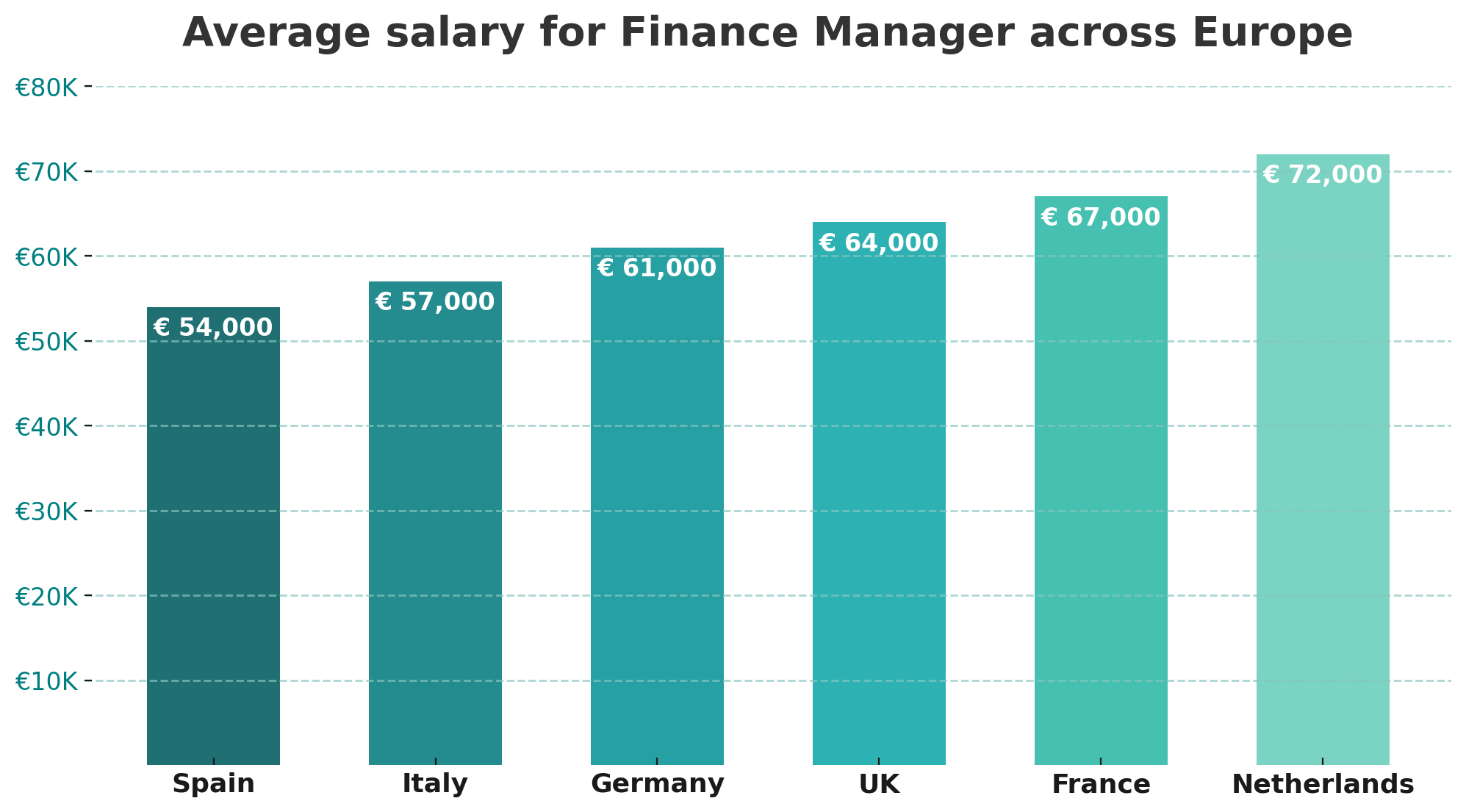 Finance Manager Salary and Pay
In Germany, finance managers earn an average annual base salary of €61,000.
In the Netherlands, the average annual base salary for a finance manager is €72,000.
In France, finance managers earn an average yearly base salary of €67,000.
The average yearly base salary for a finance manager in Italy is €57,000.
Finance managers in northern Europe earn more than their counterparts elsewhere. This is due to differences in salary and compensation regulations.
Additional pay could include cash bonuses, commissions, tips, and profit sharing.

Photo by Towfiqu Barbhuiya on Unsplash
The salary for finance managers is determined by their responsibilities, experience, company size, and industry sector. Finance managers earn the highest salaries in financial services companies. These companies include investment banks, commercial banks, insurance companies, and credit card companies.
Salaries are competitive at large global companies across various fields, including pharmaceuticals, technology, and the automotive industry. They are also competitive in the heavy industry, oil and gas, consumer goods, electronics, and consulting sectors. There are also the government, academia, and non-profit organisations.
High-Growth Industries
This means that there is a finance job for someone in every sector.
Yet, pay varies across industries, and those in fast-growing sectors can expect higher compensation.

Photo by rupixen.com on Unsplash
How To Get Paid More as a Finance Manager?
There are two viable strategies for someone looking to increase their compensation in finance. The first strategy is to specialise in some sought-after niche within finance. For example, a financial analyst who is good at creating financial models and projections should earn more than their peers.
If a company wants to grow by purchasing other companies, it may need a finance manager who specialises in mergers and acquisitions.
Increase Responsibilities As a Finance Manager
The other primary strategy is increasing your responsibilities as the finance manager. This means the person must perform well every year and receive a promotion. To help the organisation, they would need to take on extra responsibilities and do things that make a difference.
The first strategy is easier. It allows candidates to pursue advanced education courses or certifications to enhance their CVs. Yet, both approaches are viable, and the latter method would be more suitable for applicants aiming to advance to a CFO or CEO role in the future.
Is a Master’s Degree or an MBA Worth It? Should You Pursue Higher Education?
The salary for financial managers is divided according to education level. A financial analyst with an undergraduate or graduate degree has accumulated 4400 euros in income per year for their first two years.
A Master’s degree offers its possessor an average salary of between 11,000 and 12,600 euros, which is 64% higher than the income for a Master’s. Graduates receive 6900 euros per month more than students with certificates.
There will be no salary growth during the semester, despite having an active job. A compensation review occurs after completing an apprenticeship and earning a degree. In most cases, a change in position will result in about 10 per cent more salary than before. It is, thus, worth the investment.
Master’s Degree Programmes in Germany
A Master’s Degree programme or postgraduate programme in Germany costs between 19,100 and 57,200 euros for a two-year programme.
Master’s Degree Programmes in The Netherlands
Master’s degree programmes are available in the Netherlands for between €24,400 and €7,300 and last approximately two years.

Photo by Christian Wiediger on Unsplash
Employment Outlook for Financial Managers
The workforce is expected to grow by 19% by 2026. Growth varies across industries, though. Financial managers help plan and direct investments in a growing economy. They coordinate services.
Financial management is expected to focus on different specialist fields in the coming decades. This includes cash management and risk management. Companies have been accumulating cash on their balance sheets, especially when operating abroad. Regardless of how globalisation continues, the trend may continue more broadly.
Financial management seeks to apply economic principles to enhance value and effectively manage resources.
The roles of financial managers are centralised, multidisciplinary, and regulated. Trade-offs between risks and returns make them essential in industry and commerce. Most institutions realise that risk management is an integral component of financial management.
What Are the Kinds of Jobs a Finance Manager Can Have?
Every industry demands financial management. Financial accountants hold various titles, including Financial Manager, Chief Financial Officer, and Chartered Accountant. They can also be risk managers or payroll managers.

Photo by Austin Distel on Unsplash
What Does a Finance Manager Do?
Finance managers control the company’s finances and ensure its survival. They manage accounts, profits, expenses, and financial reporting. Before, finance executives had to keep financial records. Yet, the role of finance managers in today’s global economy appears to have undergone significant changes. This change is due to increased international connections and hyperconnectivity.
Companies now need to analyse their business finances, strategise and plan. Borrowers should also be aware of financial regulations, global markets, investments, and digital currencies.

Photo by Dylan Gillis on Unsplash
Financial Manager Job Description
Financial managers have many tasks, and their job varies depending on the organisation. In a business, the financial manager is responsible for handling all financial operations. In a big company, the finance manager might specialise in one area of finance.
Financial managers have daily responsibilities, including adhering to laws and regulations.
Financial management, in particular, focuses on developing and implementing financial plans for businesses. The department has the financial statements and budget. It also creates an accounting system. Below is a summary of the job responsibilities for finance managers.

Photo by Dose Media on Unsplash
Job Role Responsibilities for Finance Managers
- Financial analysis and planning. Financial managers need to determine the amount of money the company is spending on management costs. Financial managers must calculate the correct fixed and working capital required.
- Discover opportunities and maximise profit. Profit maximisation is a fundamental responsibility of any financial manager. A firm can achieve both short-term and long-term gains. Financial managers must find profitable and risk-mitigating strategies.
- Capital Requirement Estimation. Anticipating fund needs is an integral element of financial management. Before creating a budget, a finance manager who specialises in capital rules considers revenue and expenses. The accuracy of estimating costs is vital to ensuring the success of any given project.
- Wealth Maximisation. A company’s wealth can mean the difference between profits and costs. Financial managers can emphasise a more significant impact on cash flows and increase profits. The increase in earnings could boost shareholder value and increase company profits.
- Risk Management. Risks are categorised into three main areas: financial, economic, and non-economic. Financial management must protect against and prepare for future opportunities to address financial troubles.
- Tax and payroll. Many industries, such as taxation and payroll, require financial management to comply with income regulations. To perform audits effectively, auditors need to be familiar with tax laws and procedures and possess relevant training and experience. Their regular contacts involve accountants, attorneys, and auditors. Tax managers can help manage compensation packages, process tax-related expenses, prepare documents, and merge investments. To apply for tax and payroll jobs, most individuals typically require a bachelor’s degree in finance, business, accounting, economics, or a related field. Most seniors have a master’s degree.
- Dividend Decisions. Companies that are listed on the stock market, such as those on the Sensex index, must manage their shares and dividends. It’s essential to manage finances effectively when determining the company’s dividend policy. This decision should take into account market conditions.
- Liquidity Decisions. The financial system ensures that the company’s assets are stable, liquid, and profitable. Financial managers ensure safe investment management and protection against illiquidity risk.
See also the Finance Manager Job Description and Profile for reference here.

Photo by Sean Pollock on Unsplash
What Are the Skills of a Financial Manager?
Financial executives possess in-depth expertise in the field of business administration, encompassing accounting, finance, and control systems. They possess exceptional skills in mathematics and have a deep understanding of financial and business trends.
They also work on Excel and financial software applications. The manager is familiar with economic statistics and accounting principles, enabling them to make informed business decisions. They are also familiar with financial reports.

Photo by Alexander Grey on Unsplash
To learn more about a finance career, please visit our resources page or search for finance roles here.
See also Finance Manager Salary & Pay here.
Job Seekers
On the hunt for your next role? Upload your CV below and we’ll be in touch to discuss your requirements.
Employers
For employers seeking the right skills and cultural fit for your business, send us your vacancy to find out more about how we can help.
Submit CV Send Us Your VacancySearch Jobs
Popular this week
- How Does Industry 4.0 Differ From The Previous Generation?
- What Are The Main Differences Between ACA and ACCA?
- What Qualifications And Skills Are Needed To Be An Accountant?
- Top 10 Skills For A Successful Finance And Accounting Career
- Agile For Accountants: Six Steps To Provide Necessary Tools And Relevant Processes